
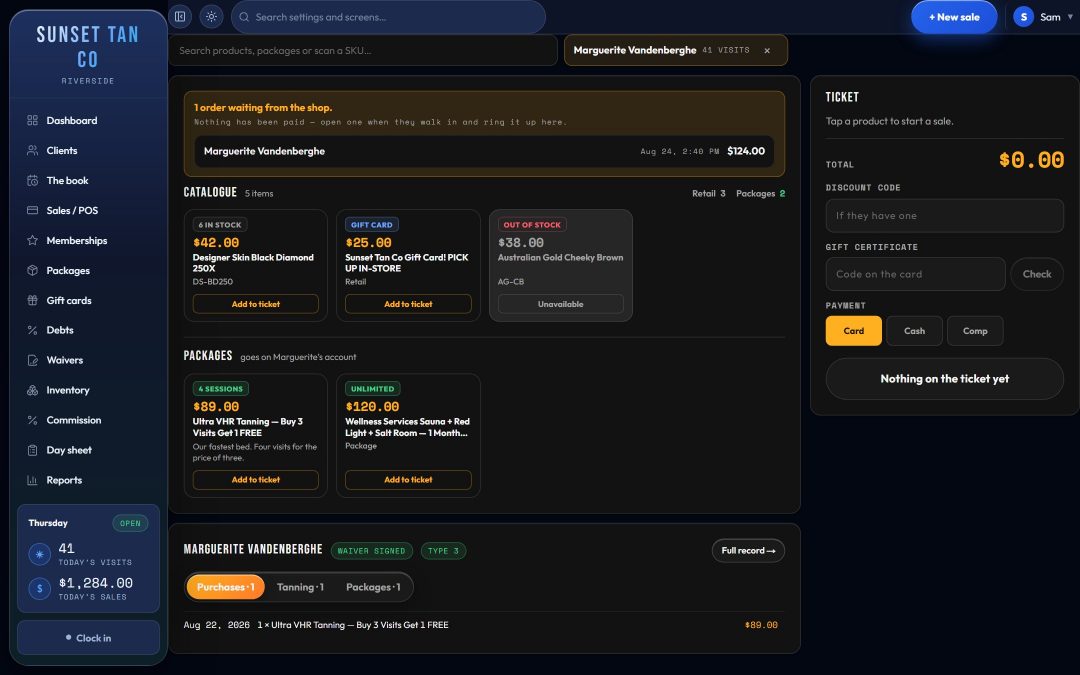
Why a tanning counter needs more than a register
A tanning sale is rarely just money for a product. A 10-session package has to become a balance on the client's account. An unlimited month has to run out on a date. A client on a level 2 package who wants the level 4 bed owes an upgrade before the bed starts. And the tanning service carries a 10% federal excise that the bottle of lotion on the same ticket does not.
A general register records the money and leaves the rest to staff memory. The costly version of that gap is a package set up as a retail item: it rings up at the right price, grants nothing, and nobody finds out until the client comes back to use a visit they already paid for. TanVision's till is built around the tanning jobs, not just the payment.
Moving from another system? Inventory → Make package turns a package that arrived as a retail item into a real package and keeps its price. Convert all does the whole catalog and leaves anything it cannot read confidently as retail. See switching to TanVision.
Packages, walk-ins, upgrades and retail on one ticket
Everything a client buys in one visit goes on one ticket: a new package or unlimited plan, a walk-in session, a bed upgrade, lotion and other retail, and gift certificates.
- Selling a package creates it on the client's account in the same step, with its terms locked in at the moment of sale: sessions, price paid and expiry date.
- Balances count down on their own as sessions are used, and daily or weekly visit limits are checked at check-in.
- The server prices every sale from your catalog before it is written. The browser never sends a price.
- Staff choose the tender every time: cash or card, with gift certificates redeemed against the ticket and an optional house account for regulars you trust. One ticket can also be split across cash, card and the client's account. Nothing is preselected, so a cash sale is never recorded as card by default.
- Receipts carry your salon's own header and footer, and show sales tax and excise on separate lines. The till can email or text the receipt to the client.
Card payments run through TanVision's built-in card processing, connected to your salon's own merchant account. With a supported card terminal at the counter, the till sends the amount to the terminal, the client taps, inserts or swipes, and the approval is recorded on the sale. You can also keep taking cards on your own machine and record them as Card.
Bed-level upgrades, charged before the bed starts
If you price beds by level, TanVision's access matrix holds the rules. For each package you decide which rooms or categories are included, which open for an upgrade price, and which are not allowed. Walk-ins get their own row at the single-visit price.
At check-in, if the client's package does not cover the room they picked, the desk sees the upgrade price, and the session does not start until the charge is accepted. The upgrade is recorded as a real sale line, so it shows on the day sheet, the close-out and the tax report like any other money. TanVision gives the client the best outcome they are entitled to: an included room before a paid one, and the cheaper upgrade before the more expensive one.
The matrix also warns you when a cheaper package opens a room that a more expensive package does not. More on bed levels and upgrades.
Sales tax and the 10% tanning excise, kept apart
The IRS says many businesses that offer indoor tanning services must collect a 10% excise tax, generally at the time the client pays, and file it quarterly on Form 720. It does not apply to spray-on tanning or to lotions and creams (IRS indoor tanning services tax center). Sales tax is a different tax, set and collected under your state's rules.
TanVision treats them as two taxes, never one bigger number:
- Each product and package carries its own sales-tax rate or a named rate category, and tanning services carry a separate excise rate.
- Each tax can be added on top of the price or marked as already included in it. An included tax is worked out of the price, not added again.
- Tax is calculated line by line and stored with the rate that produced it, so last quarter's figures still rebuild after a rate changes.
- A gift card carries no sales tax and no excise when it is sold.
- The tax report gives the excise its own section, and the day sheet shows it on its own tile.
Because spray-on tanning is exempt, set the excise to zero on your spray items. The tanning excise tax guide covers who pays and how to file, and tax and excise shows the settings. This is general information, not tax advice.
Voids that undo the whole sale
Only a manager can void a sale. A void puts the ticket's retail stock back, cancels any package the sale created, voids a gift certificate sold on the ticket, and credits back any certificate balance the ticket spent.
That matters because refunding the money while leaving the sessions on the account is how a salon gives tanning away without noticing.
Retail, promotions and gift certificates
- Products carry a price, a cost and a stock count. Stock comes off on a sale and goes back on a void, and an item can be restocked, repriced or retired without losing its sales history.
- Schedule a sale with start and end dates, and prices go back on their own when it ends. Hand out one-use coupon codes and give members a discount. The ticket shows the regular price struck through, and a Discounts given report reads it all back.
- Sell gift certificates at the till with the code shown on the receipt, redeem them on a later ticket, and see the outstanding balance the salon owes.
- Set commission per package or product as a percentage, a flat fee per item, or both. It feeds a commission leaderboard the whole team can see.
See retail and lotion inventory, gift certificates and staff commission.
Closing out the day
The day sheet shows one day line by line, every ticket, session and shift, and it prints. The reports page adds close-out, tax liability, lapsed clients and commission for any date range. There are 32 ready-made reports, including tender breakdown, package revenue, voided sales and the tax audit.
Every row of staff work names who did it, and every date and time is in your salon's own time zone, so a late sale lands on the right day. See reports.
Cards at the counter, on auto-pay and online
- At the counter: the till sends the card share of a ticket to a supported card terminal and records the approval on the sale. Voiding the sale voids the charge on the terminal too; once the card batch has settled, the refund is made on the terminal first.
- On auto-pay: a monthly package can bill a card the client saves on the card processor's secure page, with the tax, on the membership's schedule, under terms such as a setup fee and a minimum number of payments. TanVision never sees or stores the card number. See memberships and packages.
- Online: your salon's shop page can take payment at checkout. A package paid online goes on the client's account straight away, and products are handed over at the desk. See the online store.
The till has no tip line today. Want to see the till ring up a package and an upgrade? Book a demo.
Common questions
- What does a tanning salon POS system need that a regular POS doesn't?
- It has to turn a package sale into a balance on the client's account, charge bed-level upgrades before a session starts, keep the 10% federal tanning excise apart from sales tax, and undo the package when a sale is voided. TanVision does all four.
- Does TanVision process credit card payments?
- Yes. TanVision has built-in card processing, connected to your salon's own merchant account. At the till it sends the amount to a supported card terminal and records the approval on the sale, and the same processing takes monthly auto-pay and payments in your online shop. You can also take cards on your own machine and record them as Card.
- Is spray tanning subject to the 10% tanning tax?
- The IRS says the indoor tanning excise does not apply to spray-on tanning. In TanVision each item has its own excise rate, so you set it to zero on spray items. See the tanning excise tax guide.
- Can a client buy a package and lotion on the same ticket?
- Yes. Packages, walk-ins, upgrades, retail and gift certificates go on one ticket, and each line carries its own sales tax and excise.
- What happens to a package when the sale is voided?
- A manager's void cancels the package the sale created, puts retail stock back and reverses gift certificate activity on that ticket, so the voided sale and the client's account agree.